
Close your company cleanly — without liabilities left behind.
Dormant or inactive companies carry ongoing compliance obligations. Winding up through the correct legal route — Fast Track Strike-Off or Voluntary Winding Up — removes all liabilities and delivers a clean closure.
Pricing
Pricing tailored to your specific requirements
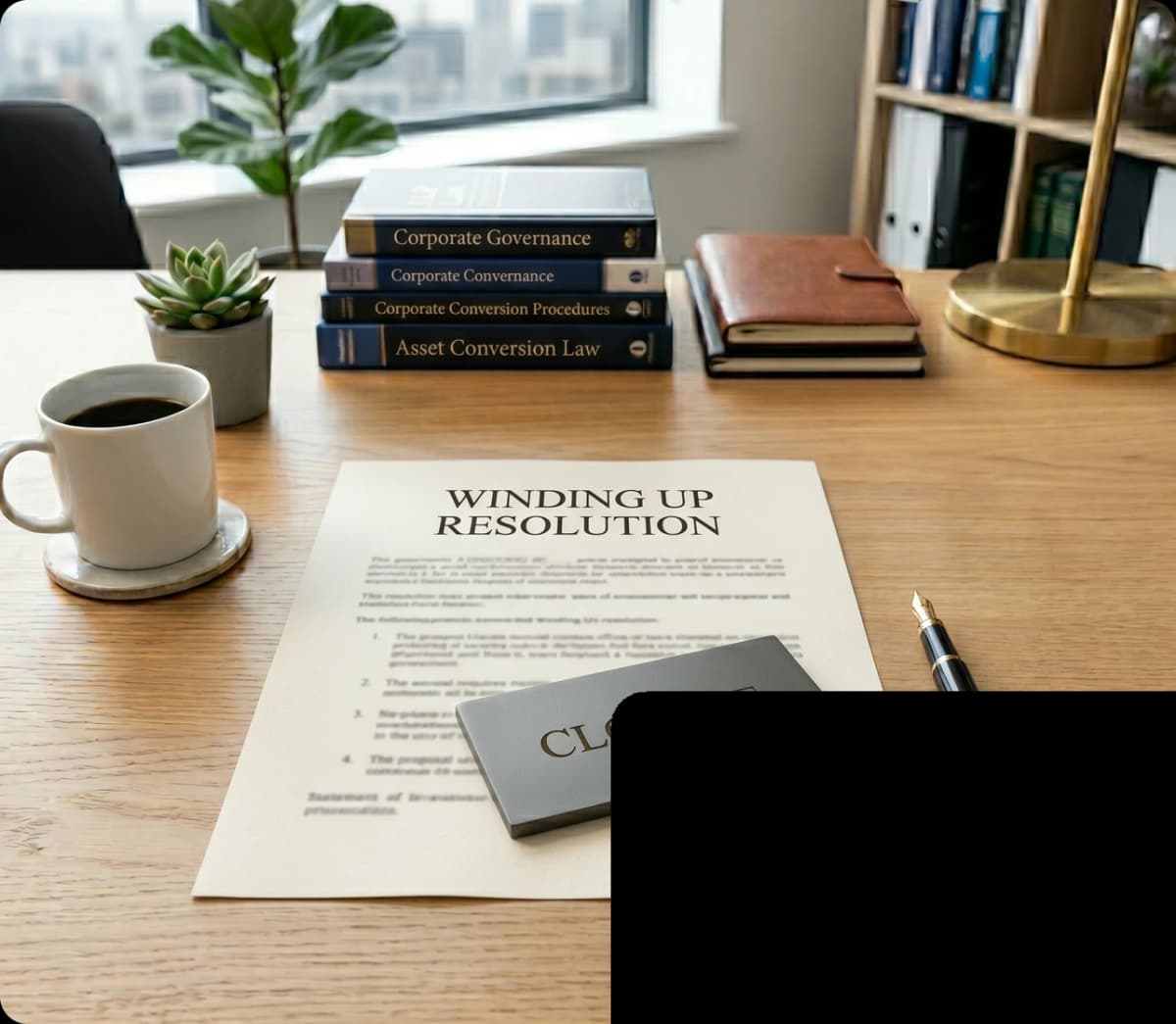
Company Dissolved in 90 Days*
*Timeline is indicative and may vary based on document verification and government processing.

What is Winding Up of a Company?
Winding up is the process of formally closing a company and removing it from the MCA register. It involves settling all debts, distributing remaining assets to shareholders, and filing for dissolution with the Registrar of Companies. Under the Companies Act, 2013, a company can be wound up voluntarily in two main ways: (1) Fast Track Strike-Off under Section 248 — the simplest and quickest route, available for dormant companies with no assets, liabilities, or business activity for the past 1–2 years; (2) Voluntary Winding Up under the Insolvency and Bankruptcy Code (IBC), 2016 — for companies with assets and liabilities that must be realised and distributed before dissolution. A dormant company that continues to exist on MCA records without filing annual returns attracts daily penalties and director disqualification — making timely winding up critical for promoters.
Winding Up Routes
Fast Track Strike-Off (STK-2)
3–4 monthsEligibility: Dormant company with no assets, liabilities, or business activity for 1–2 years
Process: Board resolution → STK-2 application → ROC public notice (30 days) → Strike-off certificate
Cost: Low — ROC fees + professional charges
Voluntary Winding Up (IBC Section 59)
6–12 monthsEligibility: Company with assets/liabilities; solvent (can pay all debts in full)
Process: Board resolution → Declaration of solvency → Shareholder resolution → IP appointment → Asset realisation → Final distribution → NCLT dissolution order
Cost: Moderate — IP fees + NCLT filing fees + professional charges
Pre-Filing Requirements
- File all pending ROC annual returns (AOC-4, MGT-7) up to the current year
- File all pending Income Tax Returns (ITR) up to the current year
- Obtain a 'No Objection' from the Income Tax Department if required
- Close all bank accounts and ensure nil balance
- Settle all outstanding liabilities — creditors, employees, vendors
- Distribute remaining assets to shareholders and record distribution in minutes
Our Process
Assess eligibility: STK-2 (fast track) or IBC Voluntary Winding Up
Clear all pending ROC filings and ITR filings before application
Obtain NOC from secured creditors if applicable
Pass Board Resolution and Shareholders' Special Resolution for winding up
File Form STK-2 on MCA portal (for fast track) — with indemnity bond and statement of accounts
ROC publishes public notice — 30-day objection window
ROC issues Strike-off Notice in Official Gazette — company is dissolved
For IBC route: IP appointed, assets realised, creditors paid, NCLT dissolution order obtained
How It Works
Share Your Details
Fill a short form or call us. We collect your requirements and all documents online — no physical visit needed.
Expert Assignment
A dedicated specialist with expertise in your service category is assigned to your case within 24 hours of payment.
Work in Progress
Your expert prepares documents, files applications with the relevant authority, and follows up on your behalf.
Delivery
Your registration certificate, legal document, or filed return is delivered digitally to your Golden Verdict dashboard.

Get Your Company Dissolved Without Any Hassle
Eligibility assessment (STK-2 vs Voluntary), STK-2 application, ROC public notice, ITR filings, liquidator appointment if required, and final dissolution order.
Pricing
Custom Quote
Pricing tailored to your specific requirements
Get Your Company Dissolved Without Any Hassle
Eligibility assessment (STK-2 vs Voluntary), STK-2 application, ROC public notice, ITR filings, liquidator appointment if required, and final dissolution order.
Pricing
Custom Quote
Pricing tailored to your specific requirements


Why Golden Verdict For
Winding Up of a Company?
Many entrepreneurs who start companies but never begin operations — or pivot away from their original business — leave dormant companies on MCA records for years, accumulating penalties and default notices. Golden Verdict assesses whether your company qualifies for the Fast Track STK-2 route (no pending litigation, no assets, no liabilities, no business for 1–2 years) and manages the complete process. For companies with assets or liabilities, we advise on the Voluntary Winding Up route under the IBC and coordinate with a licensed Insolvency Professional (IP). We also file all pending ITRs before submission of the STK-2 application.
A dormant company left unclosed is a liability waiting to find you. Golden Verdict closes the chapter properly.

Frequently Asked Questions
What is the Fast Track Strike-Off (STK-2)?+
What are the eligibility conditions for STK-2?+
What happens if a company with pending dues applies for STK-2?+
Who is an Insolvency Professional (IP)?+
Can directors of a struck-off company be disqualified?+
What happens to the company's bank accounts after winding up?+
Ready to get your Winding Up of a Company?
Dormant or inactive companies carry ongoing compliance obligations. Winding up through the correct legal route — Fast Track Strike-Off or Voluntary Winding Up — removes all liabilities and delivers a clean closure.
“A dormant company left unclosed is a liability waiting to find you. Golden Verdict closes the chapter properly.”
Built for Indian founders, CFOs, and operators.