
The partnership structure built for modern business.
A Limited Liability Partnership combines the flexibility of a traditional partnership with the limited liability protection of a company. We handle registration end-to-end.
Starting at Just
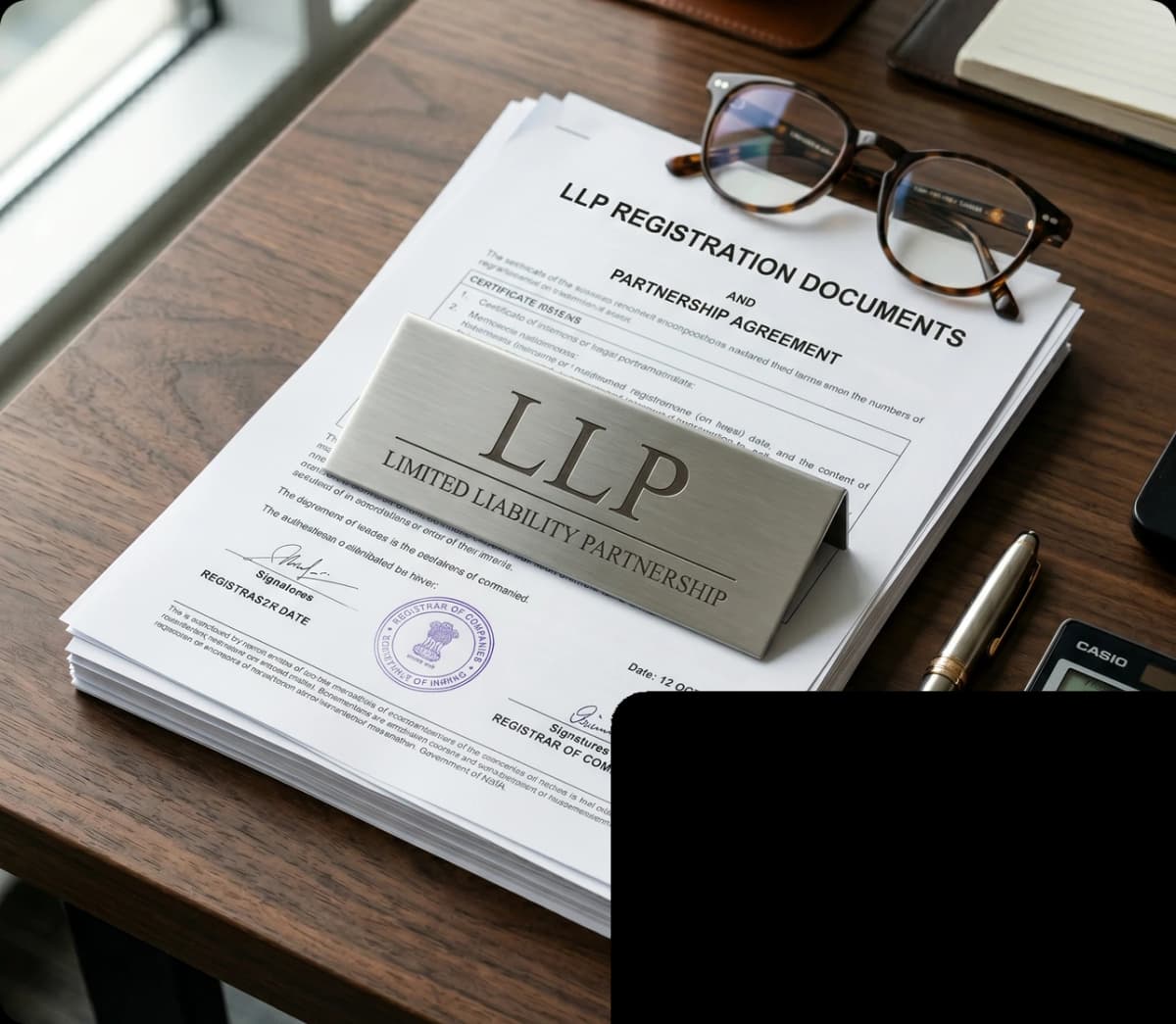
Your LLP Registered in Just 15 Days*
*Timeline is indicative and may vary based on document verification and government processing.

What is a Limited Liability Partnership (LLP)?
A Limited Liability Partnership (LLP) is a hybrid business structure introduced under the Limited Liability Partnership Act, 2008. It combines the organisational flexibility and tax benefits of a partnership with the limited liability protection characteristic of companies. Each partner's liability is limited to their agreed contribution — personal assets remain shielded from business obligations. LLPs must have a minimum of two designated partners (at least one a resident Indian), have no ceiling on maximum partners, require no minimum capital, and enjoy relatively lighter compliance requirements compared to a Private Limited Company.
Who Should Register an LLP?
Key structural facts:
2+ Partners
Minimum two designated partners required
No Min. Capital
No minimum contribution prescribed
Lower Compliance
Fewer filings vs Private Limited Company
Professional services firms — law firms, CA firms, architects, consultants
Partners who want limited liability but prefer a flexible management structure
Businesses not seeking equity investment or planning ESOP schemes
Entrepreneurs seeking lower compliance burdens and operational costs
Joint ventures between companies, individuals, or a mix of both
Small and medium businesses that want formal legal identity without heavy filings
Documents Required
Partners
PAN, Aadhaar or Passport, address proof (utility bill/bank statement), passport-size photo
Designated Partners
Digital Signature Certificate (DSC) — required for all designated partners for MCA filing
Registered Office
Electricity bill or utility bill, NOC from property owner, rent/lease agreement
LLP Agreement
Drafted by our team — specifying contribution, profit-sharing, roles, and dispute resolution
Who
Documents Required
PAN, Aadhaar or Passport, address proof (utility bill/bank statement), passport-size photo
Digital Signature Certificate (DSC) — required for all designated partners for MCA filing
Electricity bill or utility bill, NOC from property owner, rent/lease agreement
Drafted by our team — specifying contribution, profit-sharing, roles, and dispute resolution
Key Features of an LLP
Limited Liability:
Each partner's personal assets are protected. Liability is restricted to the amount of agreed contribution to the LLP.
Separate Legal Entity:
An LLP is a body corporate with perpetual succession, capable of suing and being sued, owning assets, and entering contracts independently.
No Minimum Capital:
There is no minimum capital requirement. Partners can contribute any amount — in cash, kind, or services.
Flexible Management:
Partners manage the LLP directly, unlike a company structure where shareholders and directors are separate. Internal rules are governed by the LLP Agreement.
Tax Efficiency:
LLPs are not subject to dividend distribution tax. Profit is taxed only at the partner level, making it more tax-efficient than a Pvt Ltd for profit distribution.
Lower Annual Compliance:
Only two annual forms (Form 8 and Form 11) are mandatory. No mandatory board meetings, AGMs, or extensive statutory registers unlike a company.
LLP Registration Process
Step 1: Obtain DSC for Designated Partners
Digital Signature Certificates are required for all designated partners to digitally sign MCA forms.
Step 2: Apply for DPIN
Designated Partner Identification Numbers are allotted through the FiLLiP form for new DPINs.
Step 3: Reserve LLP Name (RUN-LLP)
We file a name reservation request ensuring the proposed LLP name is unique and compliant with MCA naming guidelines.
Step 4: File FiLLiP — Incorporation Form
The FiLLiP (Form for Incorporation of LLP) is filed electronically with the MCA, along with all required documents.
Step 5: Draft and File LLP Agreement
Our legal team drafts the LLP Agreement detailing profit-sharing, rights, and obligations. Filed via Form 3 within 30 days of incorporation.
Step 6: Receive Certificate of Incorporation
The Registrar of Companies issues the LLP's Certificate of Incorporation with LLPIN — your LLP is legally constituted.
How It Works
Share Your Details
Fill a short form or call us. We collect your requirements and all documents online — no physical visit needed.
Expert Assignment
A dedicated specialist with expertise in your service category is assigned to your case within 24 hours of payment.
Work in Progress
Your expert prepares documents, files applications with the relevant authority, and follows up on your behalf.
Delivery
Your registration certificate, legal document, or filed return is delivered digitally to your Golden Verdict dashboard.

Get Your LLP Incorporated Without Any Hassle
Expert-guided LLP registration with complete documentation support, MCA filing, and LLP Agreement drafting.
Starting at Just
Get Your LLP Incorporated Without Any Hassle
Expert-guided LLP registration with complete documentation support, MCA filing, and LLP Agreement drafting.
Starting at Just


Why Golden Verdict For
LLP Registration?
LLP registration involves procuring DPINs (Designated Partner Identification Numbers), DSCs, filing the incorporation form (FiLLiP) with the MCA, and drafting a comprehensive LLP Agreement — all within strict procedural timelines. Golden Verdict's compliance specialists handle every step, from name reservation to the final Incorporation Certificate and LLP Agreement registration. We ensure your LLP Agreement accurately reflects the profit-sharing arrangements and management structure you intend, protecting all partners from day one.
A well-structured LLP Agreement prevents disputes before they arise. Golden Verdict drafts it right.

Learn More
Related Insights
 Business Setup
How to Register an LLP in India: Cost, Timeline & Compliance
The LLP is India's most under-rated business vehicle: corporate-style liability protection, partnership-style flexibility, and a fraction of a Pvt Ltd's annual compliance. Here's the full registration playbook.
 Business Setup
Pvt Ltd vs LLP: Which Structure Should Your Startup Choose?
Two of India's most popular business structures, designed for completely different journeys. Pick wrong and you'll be paying for the conversion two years later.
 Business Setup
Partnership vs LLP: The 7 Differences That Decide Your Liability
A traditional partnership and an LLP look almost identical from the outside. From the inside, they treat your liability, your taxes, and your succession in completely different ways.
 Business Setup
Pvt Ltd vs LLP vs OPC: The Ultimate Indian Startup Structure Comparison
The three structures every Indian startup founder should know cold — compared on every dimension that matters. Skim the matrix, read the decision tree, pick once.
 Business Setup
Limited Liability Explained: What It Really Means for Indian Founders
Limited liability is the single most important legal concept in modern business — and the most over-claimed. Here's exactly what it protects you from, and what it doesn't.
 Business Setup
DIN & DSC: The MCA Onboarding That Powers Every Indian Company
You can't incorporate a company in India without a DIN and DSC for every director. Here's what they are, how to get them, how to keep them valid, and the KYC trap that locks thousands of directors out every year.
Frequently Asked Questions
What is the difference between an LLP and a Private Limited Company?+
What is a Designated Partner Identification Number (DPIN)?+
Is an LLP Agreement mandatory?+
Can an LLP have a foreign national as a partner?+
What are the annual compliance requirements for an LLP?+
Ready to get your LLP Registration?
A Limited Liability Partnership combines the flexibility of a traditional partnership with the limited liability protection of a company. We handle registration end-to-end.
“A well-structured LLP Agreement prevents disputes before they arise. Golden Verdict drafts it right.”
Built for Indian founders, CFOs, and operators.