
One Person Company (OPC) Setup: A Solo Founder's Playbook
The OPC gives solo founders the legal separation of a Pvt Ltd without needing a co-founder. Here's exactly when it makes sense, how to register it, and the mandatory-conversion threshold most founders forget about.
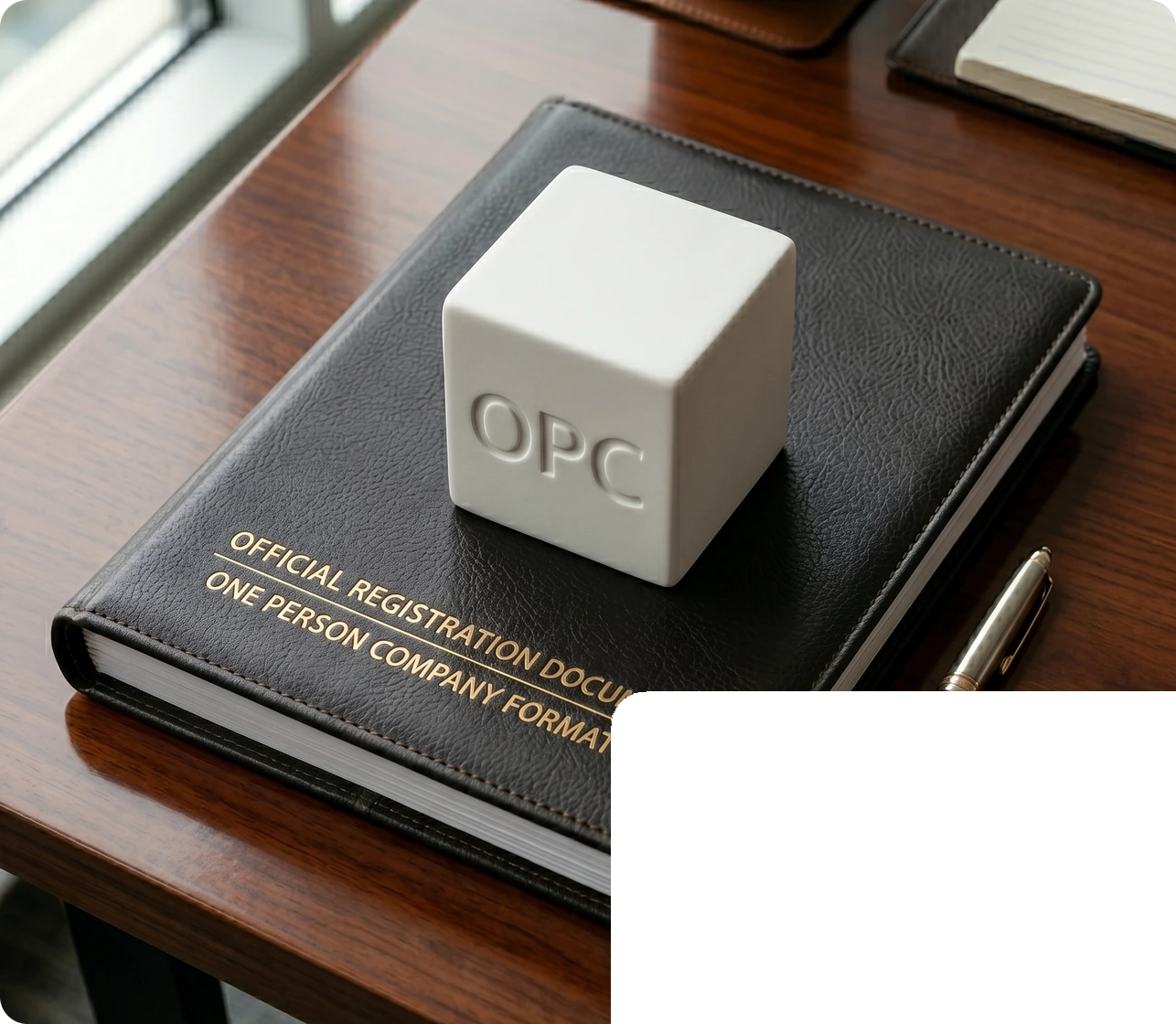
Until the Companies Act 2013 introduced the One Person Company, a solo entrepreneur in India had a binary choice: trade as a sole proprietor with unlimited personal liability, or pretend to have a co-founder to incorporate a Pvt Ltd. The OPC closed that gap. It is a full-fledged company with one shareholder, one director, and the same legal-person status as a Pvt Ltd — limited liability, perpetual existence, and a separate identity for banks, vendors, and tax.
OPC at a glance
1 shareholder + 1 nominee • 1 director minimum (must be an Indian resident) • No minimum paid-up capital • CoI in 7–10 working days • Mandatory conversion to Pvt Ltd above ₹2 Cr turnover or ₹50L paid-up capital
This guide covers what an OPC is, the nominee mechanism (its single most unique feature), the conversion ceilings nobody warns you about, the SPICe+ filing flow, and the lighter-but-not-light compliance schedule.
What an OPC is — and the nominee mechanism
An OPC is a Pvt Ltd with exactly one shareholder. To handle the awkward question of what happens to the company if that one shareholder dies, the Companies Act requires every OPC to nominate a person who automatically becomes the shareholder on the founder's death or incapacity. The nominee must be an Indian citizen and resident, and must give written consent — they don't have any management rights while the founder is alive.
- One shareholder (a single natural person, must be an Indian citizen & resident).
- One nominee (also an Indian citizen & resident, written consent required).
- One or more directors (the shareholder can be the sole director).
- Separate legal entity with its own PAN, bank account, and limited liability.
- Eligible for GST, IEC, MSME, and almost every business registration available to a Pvt Ltd.
Choosing the nominee carefully
The nominee can be changed any time via Form INC-4, but on the founder's death this becomes a paperwork race. Pick someone who will actually be reachable and willing to step in — typically a spouse, parent, or adult child — and re-confirm the nomination every few years.
When the OPC is the right call
- 1Solo consultants, freelancers, or content creators clearing ₹15–20L+ in annual revenue who want to separate business from personal risk.
- 2First-time founders prototyping a business idea before bringing in co-founders.
- 3Professionals (architects, designers, agencies) who want corporate-style credibility for enterprise clients.
- 4Founders planning to bootstrap to ₹1–1.5 Cr revenue and then evaluate conversion to Pvt Ltd.
- 5Existing sole proprietors looking to formalise without immediately taking on a partner.
OPCs cannot do non-banking financial business (NBFC activity) and cannot voluntarily convert to a Pvt Ltd in the first 2 years (except via the mandatory ceilings). Plan accordingly.
The mandatory-conversion ceiling — read this twice
This is the single rule that catches every OPC founder off guard. The Companies (Incorporation) Amendment Rules removed the older mandatory-conversion threshold in 2021, but the law still requires conversion to a Pvt Ltd when either:
Mandatory conversion triggers
Average annual turnover over the immediately preceding three financial years exceeds ₹2 crore, OR paid-up share capital exceeds ₹50 lakh. Once either threshold is crossed, the OPC must convert to a Pvt Ltd within 6 months — failing which the company is in default and directors are personally exposed.
In practice this means an OPC is the right structure for businesses in the ₹0–₹2 Cr revenue band. Above that, the ecosystem (investors, banks, ESOP-eligible employees) starts to want a Pvt Ltd anyway, so the conversion is usually a relief rather than a burden.
Registration flow
- 1Founder obtains a DSC and applies for a DIN.
- 2Nominee provides consent via Form INC-3 with their PAN, Aadhaar, and signature on stamp paper.
- 3Name reservation via SPICe+ Part A — note that an OPC's name must end with “(OPC) Private Limited.”
- 4Draft the MoA and AoA — both adapted to the single-shareholder structure.
- 5File SPICe+ Part B with AGILE-PRO and INC-9.
- 6Certificate of Incorporation issued by the RoC with the company's unique CIN, PAN, and TAN.
Documents required
Founder: PAN, Aadhaar, address proof, photograph, DSC. Nominee: PAN, Aadhaar, written consent (INC-3). Registered office: utility bill ≤2 months old, NOC from owner, rent agreement if rented.
Cost, timeline, and compliance
Cost
Government fee: ₹2,000–₹6,000 (state-dependent). DSC: ₹1,500–₹2,500. Professional fees: ₹4,999 onwards. Total typical: ₹8,000–₹13,000.
Annual compliance — lighter than Pvt Ltd, heavier than LLP
Statutory audit by a CA (mandatory). MGT-7A (annual return). AOC-4 (financials). ITR-6 (income tax). DIR-3 KYC. INC-4 if nominee changes. No AGM requirement (single-shareholder exemption).
OPCs are exempt from holding an AGM, but they still need to circulate financial statements to the shareholder within 180 days of the financial-year close. Document this even though no meeting is held.
OPC vs Sole Proprietorship — the decision in one paragraph
A sole proprietorship is unlimited liability; an OPC is limited liability. A sole proprietorship is taxed on the owner's personal slab; an OPC is taxed at corporate rates. A sole proprietorship dies with the owner; an OPC continues via the nominee. If you are clearing more than ₹15L/year in business income and have meaningful business exposure (employees, vendors, customer contracts), the OPC almost always pays for itself within 18 months in tax savings and risk insulation.
The OPC is what a sole proprietorship would look like if it were designed in the 21st century — separate legal identity, limited liability, perpetual succession. Most solo founders pick a sole prop because it's familiar, not because it's optimal.— Golden Verdict Editorial
Golden Verdict registers your OPC including nominee consent paperwork, MoA/AoA drafting, and SPICe+ filing — typically in 7–10 working days — and keeps the conversion ceiling visible on your dashboard so the ₹2 Cr / ₹50L trigger never surprises you.
Taxation deep-dive — what you'll actually pay
Understanding the tax treatment of a One Person Company is the single most under-appreciated aspect of the structure decision. Most founders ask “how do I incorporate?” and then discover the tax implications a year later — usually after they've made decisions that limit their options. Here's the tax picture in detail.
Applicable rates
Same as Pvt Ltd — 22% under Section 115BAA or 25% under regular regime + surcharge + cess.
Key deductions you should know about
Sole-shareholder OPCs can pay director salary, which is deductible to the OPC and taxed in the founder's hands at slab rates. Strategic use can move income to the lower-rate brackets.
Critical nuance
OPCs cannot raise external equity to dilute the founder's stake — keep that in mind when planning the tax structure for the long term.
Tax-planning levers worth pulling
- 1Pay yourself a director salary instead of taking dividends — your personal slab is often lower than 25%.
- 2Apply for Startup India + 80-IAC for the 3-year profit holiday if you qualify.
- 3Keep careful records of director-related-party transactions; the audit trail matters.
- 4Time the conversion to a Pvt Ltd carefully — converting MID-year can disturb the tax computation.
Tax law in India changes nearly every Budget. Treat any specific rates or thresholds in this article as a starting point for your CA conversation, not a substitute for one.
Banking, accounting & finance setup
Once your OPC is incorporated, banking is typically the second-biggest operational hurdle. Indian banks have specific documentation expectations for each entity type, and getting the current account opened smoothly determines how quickly the business can start trading.
Choosing the right bank
Public-sector banks (SBI, BoB, PNB) offer the cheapest current accounts but slowest onboarding — typically 2–4 weeks. Private-sector banks (HDFC, ICICI, Axis, Kotak) are faster (3–7 days) but more expensive in monthly minimums. Newer fintech-friendly banks (Yes, IndusInd, RBL) offer the best digital experience for startups. Pick based on whether speed, cost, or digital tooling matters most to your operations.
Documents typically required for current-account opening
- Certificate of Incorporation / Registration
- PAN of the entity
- GSTIN registration certificate
- Address proof of registered office (utility bill ≤ 2 months old)
- Identity and address proofs of all directors/partners/authorised signatories
- Board resolution (for Pvt Ltd / OPC / Section 8) authorising account opening and naming signatories
- Memorandum/Articles or LLP Agreement / Partnership Deed / Trust Deed as applicable
- Specimen signature card
- Initial deposit (typically ₹10,000–₹25,000 depending on bank's average balance requirement)
Accounting software — what to set up day 1
Most growing Indian businesses settle on Zoho Books, Tally Prime, or QuickBooks Online. Zoho is the most popular for startups under ₹5 Cr revenue — clean UI, native GST handling, e-invoicing integration. Tally remains the default for older businesses with traditional CAs. QuickBooks is increasingly popular for businesses with cross-border operations. Whichever you pick, set up the chart of accounts properly at the start — restructuring after 18 months of transactions is a nightmare.
Recommended financial hygiene from week one
- 1Open a dedicated current account; never run business transactions through a personal account.
- 2Get a corporate credit card for the entity once you have 3+ months of bank-statement activity.
- 3Set up an accounting software subscription before the first invoice is raised.
- 4Engage a CA on retainer for monthly bookkeeping + quarterly review — the cost is ₹3,000–₹8,000/month and saves far more in penalties.
- 5Track receivables religiously — most Indian small businesses die from cash-flow gaps, not unprofitable contracts.
- 6Reconcile bank, books, and GST on the same day each month — drift between these is where audit problems begin.
The petty-cash trap
Never let the entity's petty cash exceed ₹50,000 at any point. Income Tax Section 269ST attracts a 100% penalty for cash receipts above ₹2 lakh from a single party in a day, and the audit scrutiny on high cash balances is unforgiving.
Your first 90 days — the operational checklist
The first 90 days after registering a OPC are critical. This is when the entity transitions from being a piece of paper to being a functioning business. Skip the steps below and you'll spend year 2 paying penalties or recovering from inefficiencies that should have been avoided.
- 1Open the entity's current account and capitalise it with the agreed contribution from each founder/partner.
- 2Apply for GST registration (mandatory above turnover thresholds; voluntary registration recommended for B2B businesses).
- 3Apply for the Importer-Exporter Code (IEC) if any cross-border movement of goods or services is on the roadmap.
- 4Register on MSME / Udyam portal — free, takes 10 minutes, unlocks subsidy and 43B(h) faster-payment protection.
- 5Get a Shops & Establishment registration from the local municipal corporation — required by most states for any commercial premises.
- 6Get a Professional Tax registration in states where it applies (Maharashtra, Karnataka, Tamil Nadu, West Bengal, etc.).
- 7Set up payroll infrastructure (UAN/EPFO, ESI) BEFORE hiring the first employee.
- 8Engage a CA for monthly bookkeeping and a CS (or company secretary firm) for statutory compliance.
- 9Get a Class 3 DSC for the founder/director — needed for every MCA filing for the life of the entity.
- 10Set up a calendar reminder for every statutory deadline in the year ahead — this list grows quickly.
- 11File INC-20A within 180 days of incorporation.
- 12Appoint a statutory auditor within 30 days.
- 13Confirm nominee consent is on file (Form INC-3).
- 14Set up annual reminder for nominee re-confirmation.
Print this list, paste it on your desk, and tick items off weekly. The single biggest predictor of a smooth year-1 is how disciplined founders are about the first 90 days.
Year-1 compliance calendar — what's due and when
Year 1 is when most OPC compliance failures begin. The MCA, the GST department, and the Income Tax Department all run on automated reminder + penalty systems — there is no human grace period. Below is the calendar you should put into your operational rhythm from week one.
How to use this calendar
For each item: (1) set a calendar reminder 30 days before, (2) confirm responsibility with your CA/CS, (3) keep the filing receipt in your records. Half of all penalties happen because someone assumed someone else was filing.
INC-20A
- Due: Within 180 days of incorporation
- Penalty for delay: ₹50,000 + ₹1,000/day
Statutory auditor appointment (ADT-1)
- Due: Within 30 days
- Penalty for delay: Director fines
MGT-7A (Annual Return — short form)
- Due: Within 60 days of AGM date
- Penalty for delay: ₹100/day
AOC-4 (Financial Statements)
- Due: Within 180 days of FY end
- Penalty for delay: ₹100/day
DIR-3 KYC
- Due: Annually by 30 September
- Penalty for delay: ₹5,000 + DIN deactivation
ITR-6
- Due: 31 October
- Penalty for delay: ₹5,000 + interest
GST Returns
- Due: Monthly/quarterly
- Penalty for delay: ₹50/day per return
TDS Returns
- Due: Quarterly
- Penalty for delay: ₹200/day per return
Penalties compound
Most MCA late fees are ₹100/day with no cap. A six-month delay on a single filing can cost ₹18,000+. Across multiple late filings, year-end can become genuinely painful. Build the calendar discipline early.
Common founder mistakes — the long list
After registering thousands of entities, these are the mistakes that come back to haunt founders most often. The first three are almost universal — the rest are entity-specific but apply broadly. Treat this list as a pre-mortem: which of these are you about to make?
Skipping the foundational documents
MoA, AoA, LLP Agreement, Partnership Deed, Trust Deed — whichever applies to your structure, this document is the constitution of the business. Founders who sign templated versions without reading them spend ₹50K+ amending them later when investors or co-founders push back on default clauses.
Mixing personal and business finances
Running business expenses through personal accounts — or vice versa — destroys the audit trail and weakens limited-liability protection. Every single rupee should flow through the entity's account from day one.
Ignoring statutory deadlines
Indian regulators do not call you to remind you. Missing INC-20A, DIR-3 KYC, GST returns, or annual filings has automatic penalty consequences that compound daily.
Hiring without payroll infrastructure
Founders hire their first employee, agree a “take-home salary”, and discover three months later that they should have been deducting TDS, PF, ESI, and Professional Tax. Backfilling these costs is expensive and creates regulatory exposure.
Putting off proper bookkeeping
Books that are reconstructed at year-end by a CA scrambling to file the ITR are full of errors. Engage a CA on monthly retainer; ₹3,000–₹8,000/month is the cheapest insurance you can buy.
Misjudging GST registration thresholds
Many small businesses delay GST registration to “save” on compliance, miss the threshold by a quarter, and end up paying penalties + retrospective GST + interest. When in doubt, register voluntarily — the input-credit benefits often exceed the compliance cost.
Choosing the wrong entity for the next 5 years
Many founders incorporate based on advice from someone who last incorporated in 2018. Tax laws change, threshold limits change, and what was optimal in 2018 may be sub-optimal in 2026.
Under-stamping the foundational document
Stamp duty on incorporation documents varies by state — getting it wrong invalidates the document for evidentiary use. Always confirm the right stamp duty value with your local registrar.
Not maintaining minutes and registers
Statutory registers (register of members, directors, contracts, charges) and board-meeting minutes are mandatory under the Companies Act. Auditors will flag missing records; tax officers will use them as a wedge during scrutiny.
Relying on informal agreements between founders
Verbal agreements about equity, roles, salary, and exits inevitably break down once money is on the table. Write it down. Notarise it. Put it in the foundational document.
The expensive mistakes in incorporation aren't the ones at incorporation. They're the small operational habits in month 3, month 6, and month 12 that quietly create regulatory exposure no one notices — until someone does.— Golden Verdict Editorial
Frequently asked questions
These are the questions our consultation team hears most often. If yours isn't here, our compliance team is one chat away.
How long does it really take to register a One Person Company?
With clean paperwork, typically 7–15 working days. The variance comes from Registrar queries on objects, name conflicts, and any KYC mismatches. Plan for 3 weeks; celebrate if it lands in 2.
Can a foreign national be involved?
Yes, with conditions. For Pvt Ltd / LLP / OPC, at least one director or designated partner must be an Indian resident (stayed 182+ days in the preceding year). FDI rules apply if foreign shareholders are involved.
What if I want to change the registered office later?
Within the same state: a board resolution + INC-22 filing. Across states: requires a special resolution, NCLT involvement in some cases, public notice, and 2–3 months. Pick the registered office state thoughtfully at incorporation.
Do I need a physical office, or can I use my home address?
You can use a residential address as a registered office, provided you have a utility bill in the name of the property + an NOC from the property owner. The address must be a real, reachable location — MCA does conduct verification.
What's the cheapest way to incorporate?
DIY filing on the MCA portal is theoretically free of professional fees but practically costs 30+ hours of founder time AND a high risk of resubmission. Total cost of professional incorporation is ₹8,000–₹15,000 all-in; total cost of DIY-gone-wrong is typically higher.
Can I incorporate without a CA or CS?
Legally, yes for most structures (CS certification is mandatory only for certain forms). Practically, no — the post-incorporation compliance schedule is what most founders need help with, and it's cheapest to engage that help from day one.
What happens if I want to close the business in year 2?
Cleanest path is a formal strike-off under MCA's STK-2 (for inactive entities) or a voluntary winding-up. Both require all annual filings to be current. Letting an entity “go dormant” without filings accumulates ₹100/day in late fees per pending form.
Can I have multiple businesses under one entity?
Yes, provided your MoA's object clause covers the activities. If you anticipate diverse business lines, draft the object clause broadly. If you want hard separation (different brands, different liability pools), incorporate separate entities.
What does “limited liability” actually mean for me as a director?
Your personal assets are protected from the entity's debts to the extent of your subscribed capital. However, personal guarantees on loans, unpaid statutory dues, fraud, and breach of director duties can each pierce this protection. See our separate article “Limited Liability Explained” for the full picture.
Should I trademark my brand name before incorporating?
Yes. A name that clears the MCA can still be opposed by a prior trademark holder. Always check the IP India trademark database BEFORE locking in a company name, and file a trademark application in parallel with incorporation.
How does Golden Verdict handle this end-to-end?
We handle incorporation, the first-year compliance calendar, GST registration, accounting software setup, and integration with your bank's KYC team — typically under a single managed plan with a dedicated account manager. Pricing starts at ₹4,999 + government fees.
Your next step — how Golden Verdict actually delivers
Registering a OPC is the cheapest part of building a serious business. The hard work is the operational discipline that follows — and it's where most founders silently accumulate regulatory exposure, late-fee penalties, and tax-planning misses. Golden Verdict's value isn't the form-filing; it's the operating system that surrounds it.
What you get when you incorporate with us
- Dedicated account manager — a single named human you can reach by WhatsApp, phone, or email.
- End-to-end incorporation including DSC, DIN, name reservation, MoA/AoA (or equivalent), and the relevant MCA filing.
- Post-incorporation compliance plan — INC-20A, statutory auditor appointment, first board meeting documentation.
- GST registration, IEC, MSME/Udyam, Shops & Establishment, and Professional Tax setup.
- Bank account opening coordination with HDFC / ICICI / Kotak partner relationships.
- Accounting software (Zoho Books) setup with chart of accounts tuned to your sector.
- Year-1 compliance calendar pre-loaded into your founder dashboard.
- Quarterly review calls with a CA/CS to flag upcoming deadlines and tax-planning opportunities.
Why founders pick Golden Verdict
We don't see incorporation as a transactional service. We see it as the start of a multi-year compliance partnership where our incentive is to keep your business penalty-free, audit-ready, and free to focus on building. That's why our clients renew our annual compliance retainer at 92%, and why we publish every fee, every deliverable, and every SLA up front.
The right partner makes incorporation the boring part of starting a business. Boring is what you want. Boring means no surprise penalties, no scramble-month before annual filings, and no headline-grabbing compliance failure 18 months from now.— Golden Verdict Editorial
Ready to incorporate your OPC? Talk to our team via the “Get Started” button below, or directly at /one-person-company. The first consultation is free, the timeline is honest, and the pricing is published.
Ready to register?
Get expert help with paperwork, MCA filings, and post-incorporation compliance — handled end-to-end by Golden Verdict.
Start Now →